
How small outdoor projects became one of the easiest ways to make your home feel more finished.
A beautiful outdoor space used to mean a full renovation. New patio. New deck. New lawn. New planting plan. New everything.
But the DIY trend is moving in a different direction. Homeowners are no longer waiting for one big renovation to make their homes feel better. They are improving small spaces one at a time: a curb strip, a backyard corner, a path-side bed, a small gravel nook, or the awkward patch of grass that never looked quite right.
And honestly, those are often the updates people notice first.
Not because they are huge. Because they look intentional.
The new DIY trend is small, visible, and achievable
Home improvement is becoming more personal and more practical. Pinterest's 2026 Spring Trend Report shows rising interest in outdoor inspiration, with searches for "garden inspiration ideas" up 940% and "balcony makeover ideas" up 165%. That points to a bigger shift: people want smaller outdoor spaces to feel designed, not forgotten. Pinterest
Houzz is seeing a similar movement. Its 2026 U.S. Outdoor Trends Study found that homeowners are increasingly turning outdoor spaces into functional extensions of the home, with comfort and everyday living becoming a bigger priority than resale value alone. Houzz
That is the sweet spot for DIY.
People do not always need a contractor, a huge budget, or months of planning. Sometimes the best upgrade is a small project that makes the whole home feel more cared for.
Why small outdoor projects work so well
A small outdoor update can change the way your home feels from the street, from the window, or from the backyard.
It can turn:
- An empty strip into a clean gravel bed.
- A messy corner into a seating nook.
- A patchy lawn edge into a planted border.
- A side area into a path with structure.
- A forgotten backyard corner into a place to sit with coffee.
These changes are approachable because they are contained. You can understand the space. You can measure it. You can choose the material. You can finish it in stages.
That makes them ideal for DIY.
The neighbour effect is real
Every neighbourhood has that one house.
The one with the clean front edge. The one with the nice stepping stones. The one with the simple plants that somehow always look good. The one where the outdoor space feels calm, finished, and intentional.
It does not always have the biggest yard. It just has better decisions.
That is what makes people stop and notice.
A well-designed small space sends a quiet signal: someone cared about this.
And that kind of curb appeal does not need to be complicated.
What is trending now
The strongest outdoor DIY ideas are not about doing more. They are about doing less, better.
Some of the most useful directions right now are:
Gravel and stone areas
Clean, durable, and easier to maintain than small patches of lawn.
Low-maintenance planting
Ornamental grasses, compact shrubs, groundcovers, and plants that fit the amount of sun the area actually gets.
Defined outdoor zones
Houzz notes that homeowners are thinking about yards as collections of outdoor rooms, with distinct zones shaped by pathways, planters, hedges, and other simple boundaries. Houzz Pro
Smaller-scale landscapes
Houzz's 2026 Emerging Summer Trends Report also points to growing interest in smaller outdoor solutions, including searches for "permeable patio" up 137% and "native landscape" up 59%. Houzz
Backyard corners that feel useful
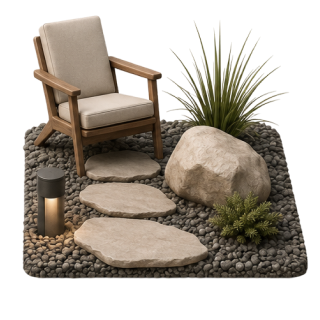
A chair, a gravel pad, a few stepping stones, a soft planting edge, and one good boulder can do more than a large unused lawn.
You do not need to impress everyone
The goal is not to design your yard for the neighbours. The goal is to make your home feel better to you.
But if the neighbours notice? That is a nice bonus.
Good design has a way of looking effortless. It makes a space feel complete without shouting. It gives your home a quieter, cleaner, more considered look.
And small DIY projects are one of the easiest ways to get there.
Start with one space
Do not start with the whole yard. Start with the area that bothers you most.
- The grass strip that is hard to mow.
- The empty corner beside the driveway.
- The backyard edge that collects weeds.
- The spot where you wish you had a small seating area.
Choose the material. Choose plants or no plants. Choose the level of maintenance you actually want.
Then build one clear, finished area.
That is how a yard starts to change.
Not all at once. One Yardlet at a time.