
A lawn can make a home feel clean, open, and familiar. For many people, a green front yard still feels like the default image of a "finished" home.
But grass was not always the obvious choice.
The modern lawn started as a symbol of wealth and status. Large open lawns became popular around estates and country houses because they showed that the owner had land that did not need to be used for food production. Over time, that image moved into suburban life. The neat green lawn became part of the ideal home: tidy, respectable, and easy to recognize from the street.
Today, grass is still everywhere — in front yards, backyards, curb strips, side yards, and narrow spaces beside sidewalks.
But the way we live has changed.
Many of these grass areas are not used for play, pets, gathering, or relaxation. They simply sit there, needing care.
And that care adds up.
In the United States, the average family uses more than 300 gallons of water per day at home, and outdoor water use accounts for about 30% of household water use nationally. In drier regions, outdoor use can be much higher. Most outdoor residential water is used for landscape irrigation. US EPA
Across the country, residential outdoor water use adds up to nearly 8 billion gallons per day, mainly for landscape irrigation. US EPA
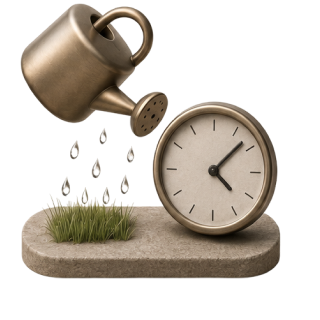
Grass also asks for time. The Bureau of Labor Statistics' American Time Use Survey shows that Americans spend measurable time on lawn and garden care every day on average. In the 2022 survey, lawn and garden care averaged 0.18 hours per day across the civilian population. That equals about 66 hours per year before counting the extra time spent by homeowners who actively maintain larger lawns. Bureau of Labor Statistics
What grass needs to stay looking good
A healthy lawn is not a one-time project. It is a repeating maintenance cycle.
Most lawns need:
- regular mowing
- watering during dry periods
- edging along sidewalks and driveways
- fertilizing
- weed control
- overseeding thin areas
- repairing yellow or bare patches
- seasonal cleanup
- aerating compacted soil
Many turfgrass lawns need around 1 inch of water per week during active growth when rainfall is not enough. For a 1,000 sq ft lawn, even 1 inch of water equals roughly 620 gallons of water. Better Homes & Gardens
That does not mean every lawn is bad.
Grass can be useful. It can be soft, open, and practical for kids, pets, sports, and larger backyard areas.
But not every patch of grass deserves that much maintenance.
The problem is the small unused lawn
The real question is not: should every lawn disappear?
The better question is: which grass areas are actually worth maintaining?
- A small curb strip.
- A narrow side yard.
- A front-yard corner.
- A patch beside the driveway.
- A backyard edge that no one uses.
These spaces often require the same type of maintenance as larger lawns, but they do not provide the same value.
They still need mowing. They still need watering. They still get weeds. They still dry out. They still need trimming around edges.
That is where efficient materials make more sense.
What to use instead
For small outdoor areas, low-maintenance materials can create a cleaner and more intentional result.
Instead of grass, you can use:
- gravel
- lava rock
- river stone
- bark mulch
- stepping stones
- boulders
- low-water plants
- ornamental grasses
- compact shrubs
- or even a no-plant material-only layout
These materials do not need weekly mowing. Many do not need regular watering. They can define a space, improve the look of the yard, and reduce the maintenance burden.
A small area can become: a clean curb strip, a quiet backyard nook, a low-maintenance front-yard corner, a simple gravel bed, a planted edge, or a path-side composition.
The goal is not to remove nature. The goal is to stop treating every outdoor surface like it has to be grass.
A more intentional yard
The lawn became popular because it represented order, space, and care.
But today, care can look different.
Care can mean using less water. Care can mean choosing materials that last. Care can mean planting only where plants make sense. Care can mean turning one awkward patch into something useful, beautiful, and easier to maintain.
That is why Yardlet exists.
We help homeowners rethink small outdoor areas and turn them into clear, buildable DIY projects.
Choose the space. Choose the material. Choose plants or no plants. Get a simple plan with quantities, layout, and steps.
Because a better yard does not always start with a full renovation.
Sometimes it starts by replacing one patch of grass that was never working very hard in the first place.